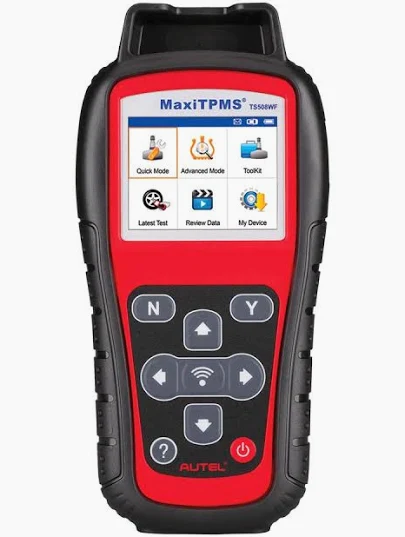
Some years ago I decided I needed to be able to read the TPMS (tire pressure monitoring system) sensors on my car. Back then the only game in town seemed to be the Autel TS508 reader, seen at right. Recently, I tried to use my TS508 reader to read the TPMS sensors on a friend’s Tesla Model Y. The reader said that it had never heard of the Tesla Model Y. What gives?
About 19 years ago, the US government started requiring that all cars provide a tire pressure management system (TPMS, Wikipedia article). The sensor, located inside the tire, would transmit information to a reader located in the wheel well of the vehicle. Until just a few years ago, all TPMS systems communicated on a radio frequency of 315 MHz or 433 MHz. And all TPMS readers, including the Autel TS508 reader shown above, knew how to communicate at these two radio frequencies, thus being compatible with all cars.
The way it works with any TPMS reader is that you turn it on and you click around to select the make and model and year of your car. And, among other things, this permits the reader to know which of the two frequencies to use to read the sensors in your car.
Why, then, would the Autel TS508 reader profess never to have heard of the Tesla Model Y?
It turns out that all Tesla Model Y cars (and all other Tesla models starting in about the year 2022) use TPMS sensors that transmit using BLE (bluetooth low energy) communication. This happens in the 2.4-GHz frequency band, which is different from the legacy 315 and 433 MHz frequency bands.
So your ordinary TPMS reader (whether made by Autel or by anyone else) is unable to read pressure data from TPMS sensors in Tesla Model Y cars.
There are newer and strikingly more expensive TPMS readers that can read BLE data in addition to 315-MHz and 433-MHz data. But it turns out that you can simply download and install a free app on your Android smart phone that is able to read BLE TPMS sensors.